
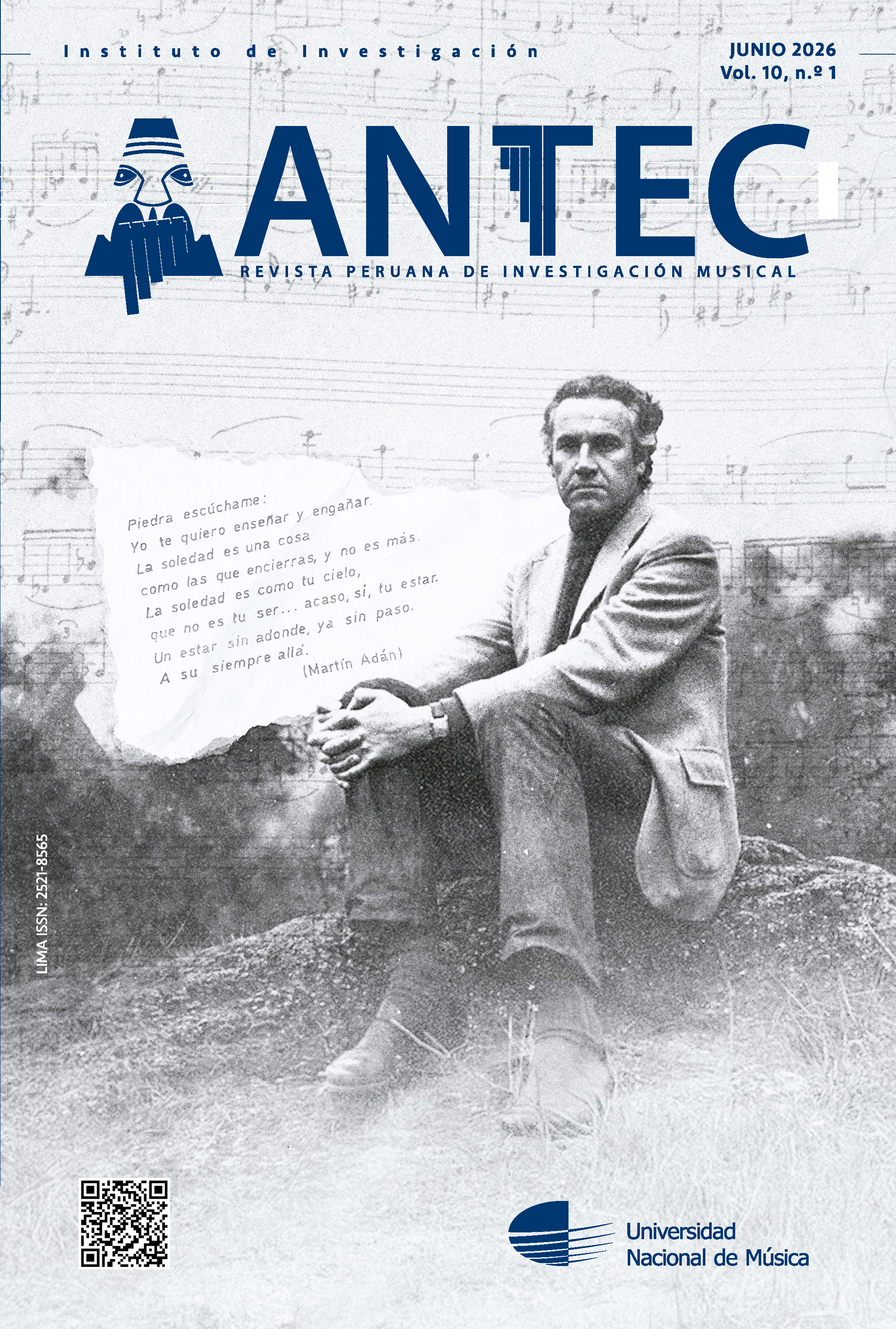
The String Quartets of Celso Garrido-Lecca
DOI:
https://doi.org/10.62230/antec.v10i1.315Keywords:
Celso Garrido-Lecca, String Quartet, Intercultural CompositionAbstract
Celso Garrido-Lecca’s string quartets are central works in his musical output. In them, he employs all the compositional resources characteristic of his style, which blends elements of Latin American folk music with his personal modernist aesthetic. His exploration of musical color through instrumental techniques is particularly noteworthy. In his later quartets, he also incorporates musical material and works from significant composers, both from folk music and from the European tradition.
Downloads
References
Belmonte, J. (2020). Cultural hybrids in contemporary music: Analytical methods and their application to intercultural composition [Tesis de maestría inédita, University of the Arts Helsinki]. Sibelius Academy.
Chiarella Viale, M. (2020). Celso Garrido-Lecca como compositor de música incidental para teatro: Rasgos de una identidad en el género musical [Tesis de maestría, Pontificia Universidad Católica del Perú]. Repositorio Institucional PUCP.
De la Sotta, R. (2007). Celso Garrido-Lecca (1926): “La música culta no tiene ninguna vigencia ya en el mundo” [Entrevista]. Resonancias: Revista de investigación musical, 11(21), 5-14. https://doi.org/10.7764/res.2007.21.2
Garrido-Lecca, C. (1975). Intihuatana. Antaras. Instituto Nacional de Cultura.
Garrido-Lecca, C. (1997). El arte en la economía neoliberal. Revista Musical Chilena, 51(187), 63-65. https://doi.org/10.4067/S0716-27901997018700015
Garrido-Lecca, C. (2001). Reflexiones sobre el compromiso social de los compositores. Revista Musical Chilena, 55(196), 87-88. https://doi.org/10.4067/S0716-2790200101960000
Griffiths, P. (1981). Modern Music. The avant garde since 1945. Dent.
Griffiths, P. (1983). The String Quartet. A History. London: Thames and Hudson.
Martínez, M. (2017). La música como existencia real: Conversación con Celso Garrido- Lecca. Lienzo, (23), 87-105.
Niño Vásquez, N. (2013). Biography. Blog Celso Garrido-Lecca. https://celsogarridolecca.blogspot.com/p/biography.html
Niño Vásquez, N. (2015). Gracias a la vida, Trío para un nuevo tiempo y el tercer período compositivo de Celso Garrido-Lecca. Revista Musical Chilena, 69 (223), 21-46. https://doi.org/10.4067/S0716-27902015000100003
Petrozzi, C. (2024). La música orquestal peruana 1945-2020. Universidad Nacional de Música.
Petrozzi-Stubin, C. (2006, diciembre). Modernismo e influencia de la música popular: Tres obras orquestales de Celso Garrido-Lecca. Conservatorio, (14), 22-33.
Ramos Rodillo, I. (2023). Dilemas nacionales y populares en el movimiento de la Nueva Canción Peruana: Casos en torno al Taller de la Canción Popular (ca. 1974-1980s). Cuadernos de Música Iberoamericana, 36, 251-274. https://doi.org/10.5209/cmib.92466
Revista Musical Chilena. (2002). Cuarteto Nuevomundo. Revista Musical Chilena, 56(198), 108-109. https://doi.org/10.4067/S0716-27902002019800012
Shpinitskaya, J. (2016). A theory of multicultural texts: The music of Erik Bergman as a phenomenon of multicultural Europe. The Semiotic Society of Finland.
Silva, R. (2014). “Música y compromiso”: Una propuesta estético-musical al encuentro con una identidad socio-política chilena [Tesis de maestría, Universidad de Chile]. Repositorio Institucional Universidad de Chile.
Smith Brindle, R. (1987). The new music: The avant-garde since 1945 (2nd ed.). Oxford University Press.
Tapia Llanos, B. (2023). Series perdidas: Una aproximación a la dodecafonía peruana. Estudio de orden no. 1 para piano de Celso Garrido Lecca (1953) [Tesis de licenciatura, Pontificia Universidad Católica del Perú]. Repositorio Institucional PUCP.
Tello, A. (2001). Antaras de Celso Garrido-Lecca o la perenne persistencia de la peruanidad. Revista Musical Chilena, 55(196), 7-26. https://doi.org/10.4067/S0716-27902001019600001
Torres, R., Quezada, J. y Tello, A. (2001). Catálogo de las obras musicales de Celso Garrido- Lecca. Revista Musical Chilena, 55(196), 27-32. https://doi.org/10.4067/S0716-27902001019600002
Downloads
Published
Issue
Section
License
Copyright (c) 2026 Antec: Revista Peruana de Investigación Musical

This work is licensed under a Creative Commons Attribution-NonCommercial-NoDerivatives 4.0 International License.
How to Cite